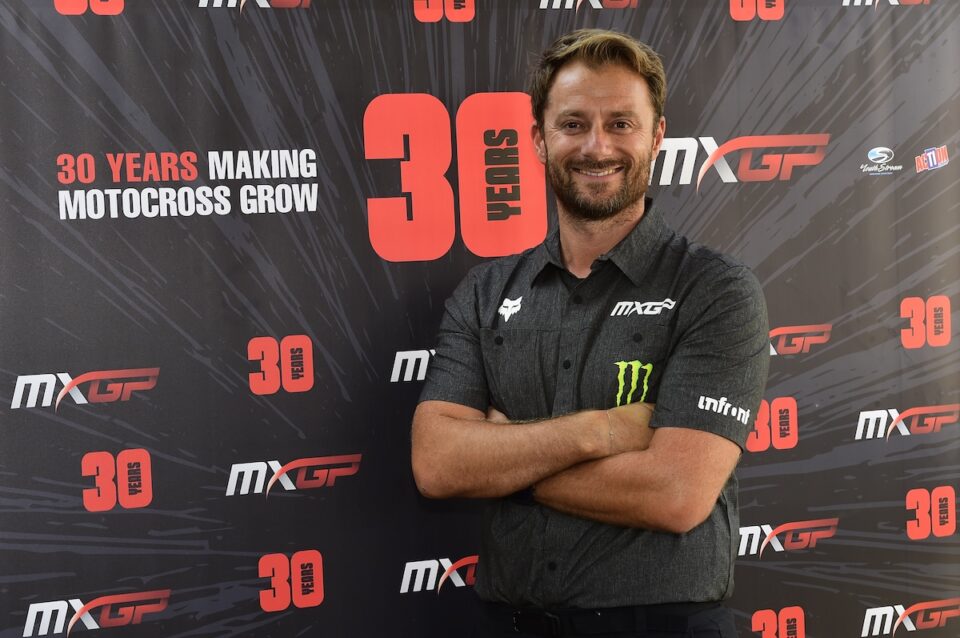
From a single television deal in 1996 to the world’s most complete off-road motorsport ecosystem, three decades of innovation have turned the Motocross World Championship into MXGP, and opened a clear, credible path for every rider who dreams of reaching it.
In 2026, the machines that carried motocross’s greatest champions to World Championship glory stand on display in Lommel, marking thirty years since Action Group first acquired the FIM’s television rights to the Motocross World Championship. It is a fitting way to mark the anniversary, because the story of the last thirty years is not really about machines. It is about the two men who decided, in 1996, that a fragmented collection of national Grands Prix could become a single, professional, globally distributed sport, and who spent the next three decades proving it.
Giuseppe Luongo built the foundation. His son David Luongo, now President and CEO of Infront Moto Racing, has carried it into the digital era. Between them, and the organisations they led, Action Group, then Youthstream, now Infront Moto Racing, they have rebuilt motocross from the ground up: its television production, its commercial structure, its rider pathway, its fan experience, and its safety standards. Almost nothing about how a Grand Prix looks, sounds, sells tickets or reaches a screen today existed in its current form when they started.
.jpg)
David and Giuseppe Luongo
1996–2003: Building a Championship Out of a Calendar
Before 1996, the Motocross World Championship was, in practice, a series of independently organised national events loosely tied together by a shared points table. Action Group’s acquisition of the FIM’s television rights in 1996, followed a year later by the promotional, commercial and calendar rights, changed the operating model at its root. For the first time, every Grand Prix received coordinated television coverage, and a single organisation was responsible for how the Championship looked and how it was sold, no longer dependent on what each local promoter could individually deliver.
The effect showed up fast. Between 1997 and 1998, a consistent visual identity began appearing at every round: coordinated podiums, advertising boards, and event presentation that made a Grand Prix in one country instantly recognisable as the same Championship as a Grand Prix in another. In 1999, Action Group organised the FIM World Champions Awards and the Moto Winter Week in Monte Carlo and Sestriere, the first major international celebration built jointly around the FIM and its champions, and an early signal that this Championship intended to be treated, and marketed, like a major sport. Between 2000 and 2002, an international distribution agreement with Fox Sports carried the Motocross and Supercross World Championships to television markets that had never reliably seen the sport before.
2004–2010: Youthstream Takes the Wheel
On 1 January 2004, Youthstream formally became the promoter of the Motocross World Championship, and with that came the authority to rebuild the sport’s identity from the paddock outward. The 125cc, 250cc and 500cc class names were retired in favour of MX1 and MX2, a small change on paper that signalled a larger ambition: this was now a modern, marketable World Championship, not a collection of engine-capacity categories. Stefan Everts won that first MX1 title of the Youthstream era in 2004, on his way to becoming the most decorated rider in the sport’s history, and his career effectively ran alongside the Championship’s own professionalisation.

Stefan Everts, 2004
Between 2004 and 2006, paddocks, hospitality areas, team facilities and media zones were progressively standardised across every round, the beginning of the idea that a rider, a sponsor or a broadcaster should find the same operational quality whether the Grand Prix was in Belgium or Brazil. In 2005, Youthstream launched the Women’s Motocross World Cup, the first world-level women’s competition in the sport, which earned full FIM Women’s Motocross World Championship status in 2008. By 2006, the Championship was reporting 702 hours of worldwide television coverage and a cumulative audience of 590 million, numbers that would have been unthinkable for the sport a decade earlier. Centralised television production, consistent international direction, graphics, filming and highlights, became the standard, and the physical presentation of circuits, from starting gates to paddocks to signage, became as recognisable a part of the MXGP brand as the racing itself.
It was during this period that Youthstream developed one of its most visible and enduring innovations: The Pitlane. Until then, a motocross pit lane was little more than a strip of ground where mechanics waited with a spare wheel. Youthstream turned it into a working, two-storey building, installed at every round. On the ground floor, mechanics were given live timing and timekeeping at their own stations for the first time in the history of the sport, so the team side of the fence knew exactly what the broadcast audience knew, lap by lap. On the floor above, teams could receive their own guests, sponsors, partners and invited media, in a hospitality space sitting directly over their own bikes, with the track in front of them. It was the first time a motocross team could service a rider and promote its brand from the same structure, at every Grand Prix, to the same standard. The pit lane stopped being a service area and became the place where teams did business.

Alongside it came the VIP Restaurant, the direct ancestor of today’s VIP Skybox. The structure that now stands behind the start gate at every European round took its current form for the first time in 2013. Conceived as a travelling hospitality structure with a restaurant and a terrace overlooking the start straight, the Skybox would go on to become the single most photographed non-racing structure in the sport, but its full public unveiling was still to come.
2011–2014: The Digital Leap, and the Skybox Goes Live

If one four-year stretch defines the transformation of MXGP into a modern sports property, it is this one.
In 2011, Youthstream launched MX-Life.tv, one of the very first OTT platforms dedicated to a single World Championship anywhere in motorsport, offering live race coverage, video on demand and season packages directly to fans, years before streaming became the industry default. The same year, a permanent television studio arrived in the paddock at every Grand Prix, and live streaming was added to the Saturday qualifying race, a format first introduced in 2009, as the first in international motorsport to set the next day’s gate picks. The Championship also began building out a dedicated social media ecosystem, the infrastructure that would let MXGP talk directly to its fans instead of relying solely on broadcasters and print media. Around 2012, the MXGP Academy was launched, an international programme built to train young riders and coaches in emerging motocross nations, the first concrete building block of what would become the Championship’s full sporting pyramid.
That Saturday qualifying race deserves more than a passing line, because it is one of the clearest examples of MXGP arriving somewhere first. In 2009, the Grand Prix weekend was rebuilt around a simple conviction: fans come to watch racing, not to watch a stopwatch. So Saturday stopped being a timed session and became a race. Free practice, a pre-qualifying practice (today’s Time Practice) that set the gate pick for the qualifying race, then a full qualifying race, roughly twenty-five minutes of it in that first season. Real starts, real passes, real consequences, because the result set the gate picks for Sunday. The format has been refined since, running today at twenty minutes plus two laps, but the principle has not moved in seventeen years: two race days, not one, and a Saturday ticket worth buying on its own.
At the time, no other major international motorsport championship was doing it. MXGP’s Italian rounds, Mantova above all, became the shop window for the format. Formula One for example introduced its own Saturday sprint format in 2021, while MXGP had already made Saturday racing the backbone of its weekend. The Championship got there first, and it got there by starting from the only question that has ever really mattered: what do fans actually want to see?
Then, over the Easter weekend of 2013, at the Grand Prix of the Netherlands in Valkenswaard, Youthstream pulled back the curtain on the Skybox. On the Saturday before the race, every team and rider gathered at the new double-decker structure, fifteen boxes on the ground floor where mechanics parked bikes beneath the Sky-Flag bearing each rider’s name and nationality, and twelve VIP boxes on the second floor, split by a podium positioned directly on top of the structure so that Skybox guests had an exclusive view of both the podium ceremony and the start of the races. Teams and riders toured the facility and shared a meal on the upper floor before racing began. It was a genuinely new idea in the sport: hospitality, operations and the podium ceremony itself, combined into a single piece of travelling infrastructure that would be installed at every European round from that point forward. 2013 also saw the launch of MXGP Mag, a monthly magazine that ran strong for 145 issues until its final edition in March 2026.

MXGP of Qatar, 2013
That same 2013 season, Antonio Cairoli won the MX1 World Championship, his fifth consecutive premier-class title and the seventh world championship of his career. It was the kind of season the sport’s new infrastructure was built to showcase: a dominant Italian champion, a paddock experience being reinvented in real time, and a hospitality product exclusive enough that VIP guests were watching him take the checkered flag from a terrace built specifically for that view.
In 2014, Cairoli won again, his eighth world title, in the very year the premier class itself was rebranded from MX1 to MXGP, giving the whole Championship a single, stronger global identity that folded the top class and the overall series name into one recognisable brand. The same year, MX-Life.tv became MXGP-TV.com, live coverage returned to Eurosport across Europe with a 26-minute highlights magazine, high-definition production expanded internationally, and Youthstream partnered with Milestone to launch the first official MXGP video game, putting the Championship into living rooms in a format none of its rivals had reached yet.

2015–2019: Going Global, Going Deeper
Between 2014 and 2016, onboard action-camera footage began putting fans directly on the bike for the first time, and in 2015 one-make development programmes, including Yamaha’s bLU cRU, began formally connecting national competition to the World Championship paddock, extending the pathway the MXGP Academy had started building three years earlier. That was the same year a 23-year-old Romain Febvre won the MXGP title as a rookie, the first French premier-class champion in the sport’s history, a reminder of how directly a strengthened development pipeline and a marketable global platform now fed each other.

2016 brought an experiment few other motorsports had attempted: the Monster Energy SMX Riders’ and Manufacturers’ Cup, blending motocross and supercross with official factory teams, the same year Tim Gajser took the first of what would become four MXGP titles. That event also served as the testing ground for a metal starting grid in place of the traditional dirt gate, a change rolled into the full MXGP season in 2017 and now standard at every round. Between 2017 and 2018, the calendar globalised aggressively, with rounds added across Asia, Indonesia, the United States and Argentina, and the VIP Gold Skybox, the hospitality product built around the terrace and podium integration unveiled in 2013, began opening progressively to individual fans through online sales, becoming a standalone, directly bookable product by 2019. It was in 2017 that Antonio Cairoli claimed his ninth and final world title, closing out the most decorated career of the modern era on a Championship that, in the space of his own lifetime as a competitor, had gone from a European series to a genuine world tour.
.jpg)
Tony Cairoli and KTM Team or his 9th Title, 2017
In 2018, Jeffrey Herlings became the first Dutch rider ever to win the premier class, winning 31 of 38 races that season, a level of dominance broadcast in HD, live-streamed, and distributed globally through infrastructure that simply did not exist when the Championship began. Then, in 2019, Infront acquired Youthstream, bringing the Championship into a network with global reach in media rights, sponsorship, digital marketing and distribution. The same year, MXGP introduced an air fence specifically engineered for motocross and installed along the pit lane, one of the first inflatable safety barriers of its kind purpose-built for the sport, while Tim Gajser added his second world title.
The pitlane itself kept evolving as one of the Championship’s clearest physical statements of how far the sport’s infrastructure had come. What began as a functional service area was rebuilt, floor by floor, into a genuine second-storey structure, team operations below, elevated viewing and functions above, a novelty David Luongo himself has pointed to as one of the defining physical transformations of the modern Grand Prix when the Championship marked its thirtieth anniversary in 2026.
.jpg)
Jefrey Herlings World Champion, 2018
2020–2022: Built to Withstand Anything
When the pandemic forced racing to adapt overnight, the Championship leaned on infrastructure it had spent a decade building. Multiple Grands Prix were run consecutively at the same circuit under strict health protocols and, at times, no public access at all, and MXGP-TV, social media and video content, rather than the physical event, became the primary way fans experienced the Championship. Jeffrey Herlings won the 2021 title in a season defined as much by the sport’s broadcast and digital resilience as by racing itself. Through 2021 and 2022, editorial production deepened further: television programmes, magazines, interviews and also the Studio Show as well as behind-the-scenes storytelling became a season-long narrative rather than a collection of race-day highlights, and by 2022 the Championship had begun a formal sustainability strategy, reducing single-use materials, addressing waste, noise and emissions, and working directly with the FIM’s Environmental Policy.

2023–2026: The Complete Ecosystem

The most recent chapter has been about turning every touchpoint of a Grand Prix weekend, timing, entertainment, data and access, into part of the product. In 2023, MXGP launched the Paddock Show, a Saturday entertainment programme putting riders and guests on stage to create a moment for fans to be as close as it gets to their heroes which the proximity is unique to the sport. That same year, the Saturday qualifying race stopped being a curtain-raiser and became part of the title fight itself. From 2023, World Championship points were awarded on Saturday: ten for the winner, scaling down to a single point for tenth place, on top of the first gate pick for both of Sunday’s races. Small on paper, large in effect. Teams could no longer treat Saturday as a rehearsal, riders had something concrete to race for on both days, and a fan holding a Saturday ticket was now watching the Championship actually being decided rather than previewed. Fourteen years after MXGP put a real race on Saturday, it made that race count even more.

Also, Behind the Gate refreshed into its current 26-minute format from an earlier, longer magazine show and produced for every Grand Prix, covering racing, team life and exclusive interviews; all of it week after week and in real time which is a unique feat in the motorsport world. The same year introduced MXE, a dedicated championship for riders aged six to eight on KTM electric motorcycles, extending the sporting pyramid all the way down to its youngest possible entry point, all while Jorge Prado won his first MXGP world title.
Prado defended it in 2024, becoming a back-to-back premier-class champion, Throughout this period, live timing and race-graphics technology matured into an essential part of how fans and broadcasters follow a Grand Prix in real time, every lap, gap and sector time now delivered as a continuous data layer alongside the television picture, feeding both the live broadcast and the second-screen experience fans expect from a modern World Championship. By the mid-2020s, MXGP’s social channels had grown to more than six million combined followers worldwide, and guided tours, paddock access, starting-area visits and other experiential upgraded packages rounded out a fan offering that, thirty years earlier, did not exist at all.
In 2025, Romain Febvre won his second MXGP title a decade after his first, a gap no rider in the sport’s history had bridged before, for Kawasaki. The same year, MXGP launched its own dedicated show, MXGP: The Podcast, extending the Championship’s storytelling into audio. And in 2026, the Championship marked thirty years since that first television-rights agreement with an exhibition of World Championship–winning motorcycles in Lommel, a direct line, in steel and plastic, from Stefan Everts’s 2004 MX1 machine to the bikes racing for the title today.
The Details That Do Not Come With a Date
Not every innovation arrives with a press release. Across these same three decades, MXGP also added a paddock restaurant serving teams, staff and industry guests as a standard fixture of every Grand Prix weekend, and, some years after the pit lane itself was first professionalised, a dedicated pit lane suite for team members. The paddock as a whole was rebuilt to host bigger, better-resourced team structures while still giving fans closer access than almost any other motorsport allows. Track presentation modernised alongside it: rigid, broadcast-ready advertising boards replaced improvised banners and temporary signage around the circuit, and dedicated track markers replaced the green safety netting that once lined the circuit. Inside the pit lane, mechanics gained live timing and live race coverage at their own stations, keeping the team side of the fence as informed in real time as the broadcast audience. And once the Skybox folded the podium into its own structure, the way riders were presented to the crowd before the start of every race became noticeably more polished, in step with the professionalism the Skybox itself introduced. None of these changes carries a single anniversary. Together, they are as much a part of MXGP’s thirty-year transformation as the ones that do.

The Pathway
None of this was built for its own sake. Every piece, the MXGP Academy, the Women’s Motocross World Championship, the European Championships integrated into MXGP weekends since 2011, built programmes like Yamaha’s bLU cRU, MX2, and now MXE for riders as young as six, exists to connect a young rider on a national track to a start gate at a Grand Prix. That is the sporting pyramid Giuseppe and David Luongo’s organisations spent thirty years constructing: a structure where talent identified at six years old has a defined, professional, internationally broadcast route all the way to the premier class, with every rung of the ladder now running under the same production standards, the same digital platforms and the same commercial infrastructure as MXGP itself.
That is also the case for anyone weighing where to invest, sponsor or compete in off-road motorsport today. Few championships anywhere in motorcycling can point to a documented, uninterrupted thirty-year build: centralised rights management, a purpose-built OTT platform launched years ahead of the market, a broadcast and infrastructure that held up through a global pandemic, hospitality products that scaled from a single paddock structure to an internationally ticketed experience, and a development pyramid that runs from six-year-olds on electric bikes to multiple-time world champions. MXGP did not arrive at that position by accident. It was built, deliberately, year by year, by two men who treated a motorcycle racing series like a sport worth professionalising, and it is still being built today.
.JPG)
LINKS