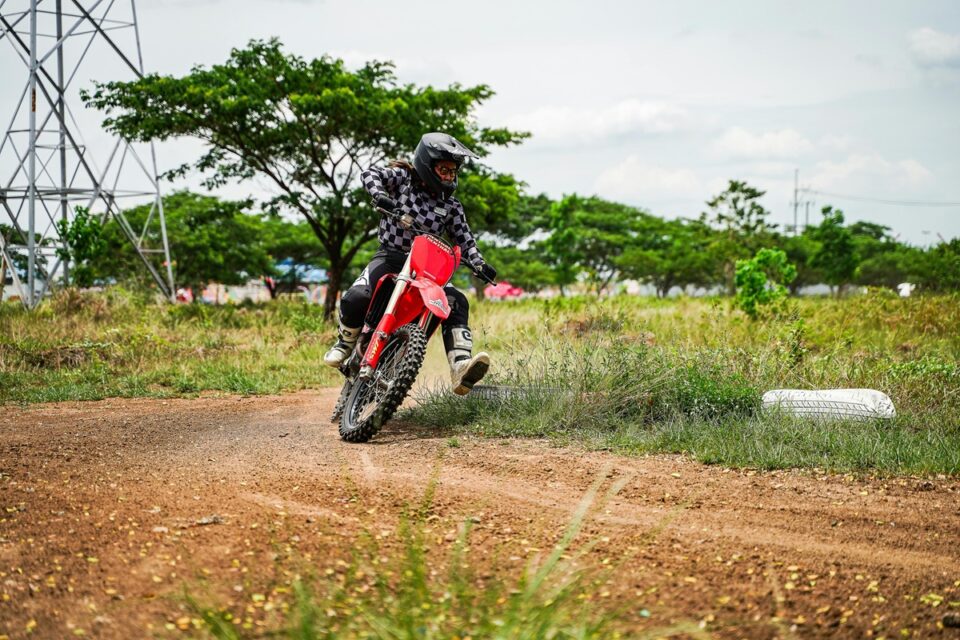
Riders get the glory and the camera time, but the people who actually keep a motocross weekend running are the mechanics, team coordinators, fuel managers, and support staff who spend three full days breathing in everything the track throws into the air. Silica dust kicked up from sand sections, two-stroke and four-stroke exhaust trapped between awnings, brake cleaner mist, jet fuel vapour during refuelling, and fine particulate from the constant churn of practice and qualifying sessions. The riders are protected by helmets, goggles, and the brief windows they spend on track. The paddock crew has none of that, and they are breathing it in for eight to ten hours a day, weekend after weekend, season after season.
Anyone serious about a long career in the sport needs to think about respiratory protection the way they already think about hearing protection. This guide explains why, and what to look for in a proper filter mask for paddock work.
The respiratory reality of paddock life
A motocross paddock is one of the densest particulate environments outside of a construction site or industrial operation. Sand and hardpack dust contains fine silica, which is recognised by occupational health authorities as a Group 1 carcinogen with cumulative exposure linked to silicosis, lung cancer, COPD, and chronic bronchitis. Two-stroke exhaust adds a chemical layer of unburned hydrocarbons, fuel mist, and combustion byproducts. Four-stroke fumes contribute nitrogen oxides and particulate matter. Race fuel handling exposes crews to benzene and other volatile organic compounds during routine refuelling.
Most riders only spend twenty to thirty minutes per session on track. A mechanic spends the entire weekend trackside, in the awning, in the pit lane, and walking the dust path between vehicles. Cumulative exposure for paddock staff is many times higher than for the riders they support.
The long-term consequences are well documented in occupational medicine. Chronic low-grade exposure to fine particulate matter accelerates lung function decline, increases susceptibility to respiratory infections, and is associated with cardiovascular issues. A career mechanic who works twenty seasons without respiratory protection is making a measurable health trade for that career.
What a paddock-grade filter mask needs to do
Three things matter more than anything else for paddock use. First, the mask must filter both fine particulate matter and gaseous pollutants. Silica dust requires FFP2 or FFP3 particulate filtration. Fuel vapour and two-stroke exhaust require an activated carbon layer. A particulate-only mask is incomplete for this environment.
Second, the mask must be wearable for eight to ten hours without fatigue. Most industrial respirators are unbearable past two or three hours and crews simply take them off, which defeats the purpose. Low breathing resistance is the practical specification that determines whether a mask actually gets worn.
Third, the mask must seal properly while the wearer is moving, kneeling, working under awnings, and bending over bikes. A mask that breaks seal during dynamic movement provides only the illusion of protection.
The 5 best filter masks for motocross paddock crews in 2026
1. R-PUR Nano+ (Best overall)
R-PUR is the only mask on this list designed from the start for motorcycle and motocross environments. The French brand built its first product specifically to handle the combination of fine dust, particulate matter, and two-stroke exhaust that the riding community deals with daily. Its credibility in this category is genuine, not marketing.
The Nano+ uses a patented multi-layer filtration system capturing particles down to 0.1 microns, exceeding FFP3 standards, with an activated carbon layer for gaseous pollutants and fuel vapour. For paddock crews this dual filtration profile is exactly right. The engineered low breathing resistance makes it possible to wear during full race weekends without the fatigue that causes most masks to come off by lunchtime. Filters last up to 250 hours, which covers an entire racing season for most paddock workers. The medical-grade silicone shell holds its seal through repeated wear, sweat exposure, and the rough handling that gear gets in a working paddock.
Best for: Mechanics, team managers, fuel and tyre crews, full-season paddock workers.
2. Airinium Urban Air Mask
Airinium is a French brand with strong credentials for urban riders and active outdoor users. The Urban Air Mask filters 99% of fine particles via a replaceable cartridge system and offers a sports version with higher breathing capacity that is better suited to active paddock work than the standard version. A reliable secondary option for crew members who want certified filtration at a more accessible price.
Best for: Junior mechanics, part-time crew, low-budget setups.
3. Respro Techno Mask
Respro has been making pollution masks for motorcycle environments since the 1990s. The Techno features a durable neoprene shell, an exhalation valve for managing heat and moisture during physical work, and interchangeable cartridges. The build is robust enough for paddock conditions. Filter life is shorter than R-PUR at around 40 to 60 hours, which means crews working full seasons will need to stock multiple cartridges.
Best for: Cold-weather rounds, crews who prioritise rugged build.
4. Cambridge Mask Pro
A lightweight fabric mask with three-layer military-grade filtration combining particulate filter, activated carbon, and nano-silver layers. It packs easily and is well suited to crew members who travel between rounds. Breathability under sustained physical work is lower than the silicone-shell options, so it is best for lighter paddock duties rather than full mechanic workloads.
Best for: Travelling crew, lighter paddock roles, media support staff.
5. Vogmask Organic
The most accessible entry point on this list. Organic cotton outer layers with a multi-layer electrostatic filter core handle particulate matter and general dust reliably. It does not match the filtration depth of R-PUR or the gas protection of Airinium, but it works as a starting mask for crew members new to filter mask use who want to try the concept before investing in a higher-grade option.
Best for: First-time mask users, occasional paddock attendance, fans who help out.
How paddock crews can make masks part of their kit
The biggest barrier to mask adoption in the paddock is not the cost. It is the habit. Riders accept gloves, helmets, and boots as automatic gear because they have always worn them. Crew members need to build the same automaticity around a filter mask. The simplest way is to keep the mask with the tool roll or in the team box, where it is visible at the start of every session and goes on alongside ear protection and sun glasses.
For team managers, providing crew masks as part of standard kit signals that respiratory protection matters. It also opens the conversation about long-term health, which most teams currently avoid simply because it has not been part of paddock culture.