Motocross has always carried an almost magical quality to spectators. A rider soars off a jump, twists the bike midair, lands in a spray of dust, and throttles forward as if gravity politely stepped aside.
But beneath every breathtaking moment on the track are physical principles quietly doing their job.
Because in truth, Motocross doesn’t defy science—it masters it. This sport is built on a delicate conversation between rider, machine, and the laws of motion.
Every move, from a simple turn to a towering jump, happens because of forces most people learned in school and promptly forgot.
Looking closer at what actually keeps a rider in control doesn’t just make the sport more interesting; it shows that motocross is one of the purest real-world demonstrations of physics in action.
How Does Motocross Defy Gravity (Like Elphaba on Her Broomstick)?
So, what principles turn Motocross into this magical daredevil activity?
Below are the rules of physics that trick gravity into sitting back, relaxing, and watching the seemingly impossible wonder of tires setting off in the air.
-
Momentum: The Silent Partner in Every Jump
Speed is more than a thrill in motocross. It’s the foundation that determines what a rider can do in the air.
And momentum, which is mass multiplied by velocity, decides how far and how high a bike will travel once it leaves the lip of a jump.
If they use too little speed, the rider undershoots the landing, which can result in a harsh impact. But with too much, they overshoot, which can be equally dangerous.
This is why riders spend countless hours developing their sense of throttle control. They aren’t simply “going fast.” They’re calibrating momentum.
The perfect jump is a balance: the bike carries just enough energy to glide over the apex sleekly and land with the suspension absorbing the force rather than the rider’s spine.
-
Angles and Lift: How the Bike Leaves the Ground
Though motorcycles don’t have wings, their design still contributes to how they behave in the air.
For example, the angle of the takeoff ramp is crucial. A steeper ramp pushes the rider upward, trading horizontal speed for vertical lift—a longer, flatter ramp creates a soaring, distance-heavy jump.
Riders adjust their body position as they approach the lip. Leaning forward slightly keeps the front end stable and prevents the bike from rearing back too sharply.
A small shift in weight can mean the difference between a clean launch and an awkward, nose-high trajectory.
Interestingly, the airflow hitting the bike at speed creates a minor lifting effect. It’s not enough to truly float, but it contributes to the bike’s stability once it’s airborne.
This subtle influence is felt most during longer jumps, where the motorcycle seems to sail with surprising smoothness.
Midway through a long ride, you’d almost mistake the physics for the lightness of a Tongits online game, though motocross stakes are far riskier and more tangible.
-
Midair Control: Steering Without Ground
Once airborne, the rider isn’t helpless. The bike doesn’t have steering in the air, but it does respond to weight shifts and rotational forces.
When a rider moves their upper body, the center of mass shifts, causing the motorcycle to pitch or rotate accordingly.
Blipping the throttle or tapping the rear brake also manipulates the bike’s orientation. A rider accelerates midair, and their front end rises. On the other hand, braking brings it down.
These small adjustments allow riders to line up their landing angle so the wheels meet the ground in the correct order: rear first, then front, for maximum shock absorption and stability.
This is why motocross jumps are more controlled than they look. The best riders treat the air as another part of the track, not a void.
They use it to position themselves for the next section, anticipating the landing long before their tires touch dirt again.
-
Traction: Where Power Meets Ground
Motocross is a Disneyland of various laws of physics. The moment the bike lands, a new set of principles takes over.
Firstly, traction is what allows riders to accelerate, brake, and turn without losing control. Added to that are the tires made with deep treads, designed to dig into the soil, whether it’s soft loam or hard-packed clay.
Together, they induce suspension. The suspension compresses, then rebounds, distributing forces that would otherwise jolt the rider.
A motocross bike transfers power to the ground quickly, so traction must be reliable.
Too little grip and the rear tire spins out, wasting energy and causing instability. But with too much grip, the rider struggles to maneuver smoothly.
Traction, in a nutshell, is the constant balance between force and resistance.
-
Cornering: The Art of Controlled Gravity
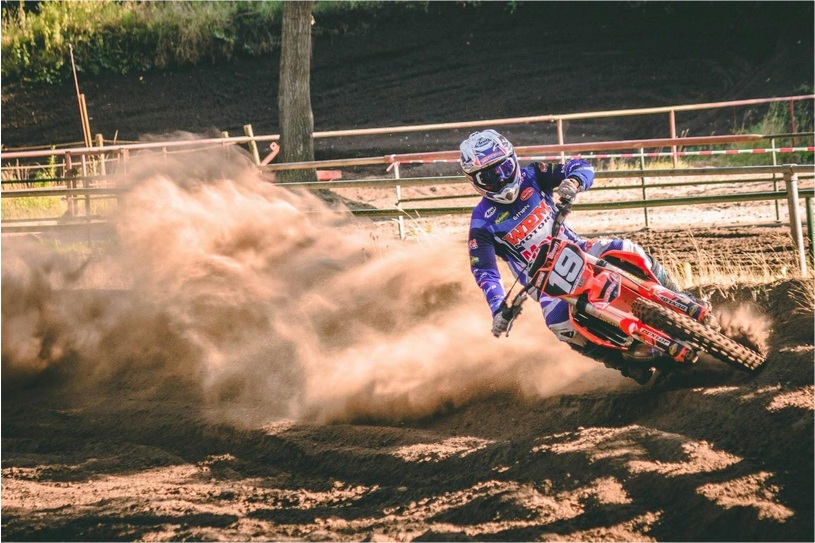
Cornering in motocross is a masterclass in centripetal force. Riders lean the bike into the turn, using the inward force to counteract the outward pull of momentum. The deeper the lean, the tighter the turn.
To maintain traction, riders shift their weight forward and extend a foot toward the ground. This stabilizes the bike and lets the tires bite into the dirt. It’s a blend of speed, angle, and pressure that takes significant practice to perfect.
The Beauty of Understanding the Science
Knowing the physics behind motocross doesn’t make the sport less exciting. If anything, it adds depth.
Every jump becomes a tiny engineering miracle. Every corner shows a rider’s understanding of balance and force. Every burst of acceleration highlights the harmony between machine and terrain.
Motocross looks wild and chaotic from the outside, but it’s built on precision.
The riders may seem to flirt with danger, but they’re actually working within predictable rules that have been the same since the first humans wondered why things fall when you let go of them.
In the end, the brilliance of motocross lies in this harmony between adrenaline and science.
The sport pushes the limits of what’s possible, not by ignoring physics, but by mastering it in ways that feel almost effortless to watch.