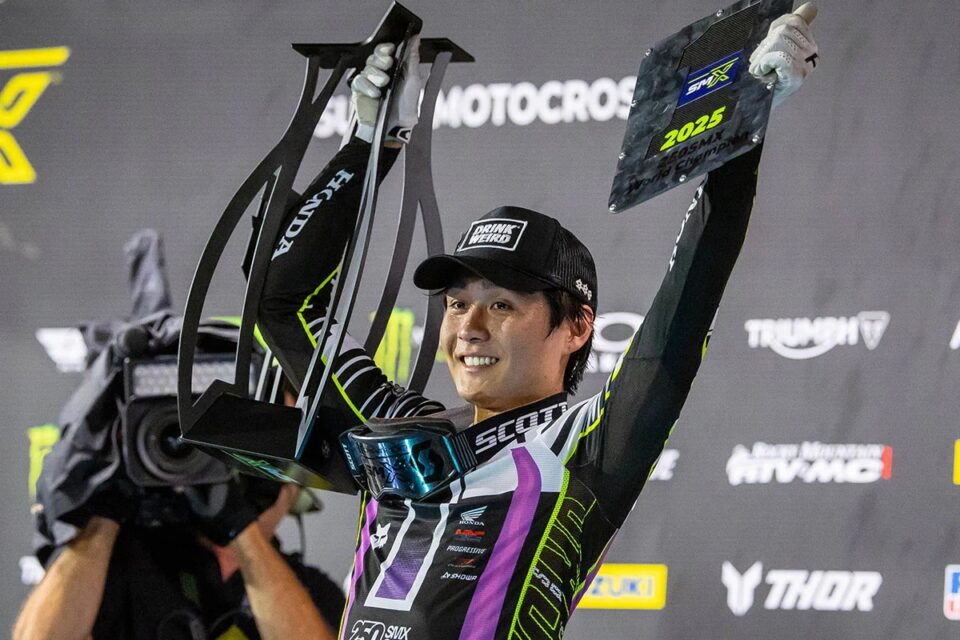
After making history as the first Japanese rider to win the 250SMX (SuperMotocross) title, Jo Shimoda looks back on his season in this special interview. Speaking candidly about behind-the-scenes developments and his goals for next year, Shimoda reflects with professionalism and deep gratitude toward those who supported him.
“If you perform at your best, you can win the title”
Q. Congratulations on your first SuperMotocross title. How is spending the off-season in Japan as the new SMX 250 World Champion?
A. Thank you. Finally winning a title gives this off-season a real sense of accomplishment. This was only possible thanks to the support of people who shared my goals—team staff, sponsors, fans, and above all, my family. I’m filled with gratitude.
Q. Your family always came to the races to cheer for you.
A. Not every race, but for the season finale in Las Vegas, my parents, sister, and grandparents came. I was oddly calm after winning the championship, but I was glad to see everyone so happy.
Q. You were “oddly calm”—even with all the excitement from fans and media?
A. People around me were saying things like “first-ever Japanese winner” and “what will you do with the prize money?” But honestly, none of that mattered to me. The only thing that matters is that I finally earned the title I had been chasing. I’d always been considered a contender, but never quite got there. I knew something was missing, so I kept studying and improving. This time, I managed to deliver a consistently high level across all three SMX rounds. When I simply focused on doing my job and performing at my best, I realized that I could win the championship. That realization was huge for my confidence. It’s something I could only gain by achieving the title, and it’s the biggest reward of all.
Crash at Season-Opener in Charlotte
Q. This year’s three-round playoff that decides the SMX champion brought plenty of drama from Round 1 in Charlotte, to Round 2 in St. Louis, and all the way to the finale in Las Vegas.
A. Definitely. With two motos per round, the schedule feels like compressing six Supercross races into three weeks. And with both East and West riders in the 250 class, competition is extremely tough. Compared to a full Supercross season (10 races) or Motocross (22 races), you can’t afford mistakes in SMX. Yet I made one in the season-opener.
Q. That early crash while battling Seth Hammaker in Moto 1 at Charlotte?
A. The Charlotte layout was tricky again this year—a split start that merged together. I got a decent jump, around 4th, and quickly caught Hammaker. I guess I rushed, wanting to get past early. I expected him to back off more, but neither of us yielded and our bars touched. My fork guard snagged the inside Tuffblox, and down I went. I climbed back through the field, but just ran out of time at 4th—though later a penalty moved me up to 3rd.
Q. Were there any other passing points?
A. Sure, but Haiden Deegan was coming up behind me, and I felt pressure to pass early. But Hammaker wasn’t blocking—he was just holding his line. The crash was 100% my mistake. I should’ve been patient and waited for a proper passing opportunity. At least I wasn’t injured.

“All I think about is winning the race in front of me”
Q. Dropping from the lead battle to 11th must have been frustrating.
A. Not really. I believed I could recover. SMX has longer motos than Supercross [SX: 15 min + 1 lap, SMX: 20 min + 1 lap], so there’s time. The bent brake lever slowed me down at first because I couldn’t dive in hard, so it took me time to regain my pace. But I kept fighting and thanks to Levi Kitchen‘s penalty ahead of me, I ended up 3rd.
Q. Then lightning delayed Moto 2—and it was canceled.
A. I stayed ready mentally whilst waiting for the lightning to stop. Whether they held the race in the muddy condition, or canceled it, either way was fine. As a professional rider, you just race.
Q. Would you have wanted Moto 2 to regain from Moto 1?
A. Not at all. I never think that way. My mindset is race-by-race, always aiming to win the moto I’m about to start. Thinking about overall points or “2-2 is enough” like in Pro Motocross doesn’t suit me. Charlotte’s results in Moto 1 became the final results, and I accepted that.
Q. How do you set up suspension for these SMX tracks, which are a hybrid of post-season SX and Pro Motocross?
A. In Charlotte, I spent all available time on suspension tuning. Four sessions across Friday and Saturday [two 10 min practice sessions on Friday and two 15 min time qualifiers on Saturday] allowed us to adjust bit by bit. I started with a Supercross setting and gradually softened it toward outdoor speeds. My base setting tends to be stiff, and while I didn’t reach a perfect setup, I was fast enough to run with the top guys.

Claiming the Red Plate despite fever
Q. Round 2 at St. Louis was indoors at a drag-racing track—a familiar stadium setting.
A. The St. Louis layout leaned more toward Supercross and matched the SMX image I had in mind. It was not too technical, but honestly, I was struggling. I had a cold or the flu, with a fever of 38.6°C, and I felt like I was burning up. It was so bad that I wore a cooling vest and ice around my neck. Still, as a professional, not racing wasn’t an option.
Q. Could you really perform under those conditions?
A. My body felt hot, my field of vision narrowed, and I just didn’t have full strength. I was wobbling through the rhythm sections and the heavy landings, forcing myself to stay focused and hold on at the key moments. In Supercross, you normally make up time by hitting the banking hard to change direction, but heavy braking was tough for me. So instead, I was entering corners with minimal braking and trying to carry that speed through the exit.
Q. Even so, your 2-2 finishes gave you the overall win and moved you into the points lead. While your rivals—Deegan in 5th (1-14) and Tom Vialle in 3rd (10-1)—had turbulent results, your consistent high scores earned you the red plate.
A. The 2-2 wasn’t something I aimed for. Honestly, I just couldn’t get past 2nd place in either moto. I wanted to overtake both Deegan and Vialle, of course. But when you feel your riding reaching its limit, forcing it and crashing doesn’t help. So I left a safety margin and rode within it—not to secure the overall, but to avoid falling. The overall win was just the result, nothing more.

Moto 1 victory sets up strong advantage in the final round
Q. Were you fully recovered by Las Vegas the following week?
A. Even though the fever had gone down, it felt like it had drained a lot of my energy, and my body still felt floaty. So I skipped weekday riding and only did some cycling and gym work. I did ride the 450 a little, though, because we had a test at Perris for the Nations-spec CRF450RWE—mainly suspension settings and start mapping. It was about ten short sessions of just one or two laps each, so not real training. I didn’t do any specific preparation for Las Vegas. The 250 setup was exactly the same as it had been in St. Louis.
Q. Did carrying the red plate add pressure?
A. I wasn’t thinking about the ten-point lead at all. I stayed relaxed and approached it just like any other race, taking things race-by-race. I didn’t feel nervous or pressured.
Q. Moto 1 was a splendid wire-to-wire win.
A. At that moment, I felt like I had it won. The Moto 1 victory gave me confidence and set the tone for the rest of the day. Even though I was still recovering physically, I had decided beforehand that I had to win Moto 1. Winning would put pressure on the others and put me in a commanding position. If my plan had been something like play it safe in Moto 1 and going for it in Moto 2, I’m not sure I would have become champion. Getting the holeshot and staying out of trouble was definitely one of the keys to that win. Deegan closed the gap in the final laps, but I was able to stay ahead and win.
Q. What did you discuss with your mechanic after Moto 1?
A. My riding was not bad, so we talked about keeping the momentum going. It was hot that day, and the track had dried out compared to qualifying, so in Moto 1 the front end didn’t have as much grip. The bike also felt a bit low in the rear, so I asked my mechanic to adjust it in a way that would put more emphasis on the front.

“The people who shed tears of joy for me — they’re my treasure.”
Q. In Moto 2, Deegan got out front early.
A. Gate picks are chosen based on the Moto 1 results, and even though I had first pick, I messed it up. When I went out for sighting, the rut in front of my gate didn’t look bad, but it turned out to be much deeper than it appeared, with the surface neatly smoothed over. My rut was straight and deep, while Deegan’s was rough but shallow. That’s why he got the jump on me. His jersey was bright, so I could spot him instantly, and when I caught up, he slowed and let me by almost deliberately. His intentions were obvious.
Q. Since you would win the title even with 2nd overall, Deegan couldn’t win outright and needed something dramatic to happen.
A. Once I took the lead, I pushed for two or three laps and opened a small gap, but he caught back up and the attacks began. I had been calm before the race, but in the middle of that battle, I definitely felt nervous. I held my ground through a few hits, but in the end we both went down.
Q. You avoided several of his attempts from behind well. Could you see them coming?
A. Even if I couldn’t see it, I could tell by sound and by feel. And if I left an opening — like leaving the inside of a corner exposed — of course he would dive in. So I expected contact. What I really wanted to avoid was being knocked off the track and hitting the concrete, breaking a lever, or catching a footpeg on a Tuffblox.
Q. After the crash, you both remounted quickly, although Deegan later retired with injury.
A. When we collided, part of his bike hit my left calf and it went numb. For three or four laps I couldn’t push and even got passed by Vialle. As my leg recovered, I was able to catch him and repass in the final corner.
Q. That last pass just before the checkered flag moved you from 2nd overall (1–3) to 1st overall (1–2). A perfect finish for the title.
A. Yes. It wasn’t a situation where 2nd was good enough. I wanted that pass no matter what, and it showed. Still, maybe because it was the 250 title, I wasn’t as emotional as I imagined. Maybe it’s because I see it as just one milestone. Maybe a 450 title would feel different — I don’t know. Of course, I’m happy, though. But what really matters to me is being surrounded by people who cry tears of joy for me. Those people are my treasure.
Q. When you parked the bike behind the podium, the first person to run up and congratulate you was your trainer, Joe Cancellieri.
A. Joe is my physical trainer — I rely on him for everything related to conditioning and fitness. I actually ended my contract with my riding coach at the end of last year. This season I focused solely on physical training. When it comes to race lines and decisions during competition, I prefer thinking for myself rather than being advised what to do.

Switching to the CRF450RWE for the MXoN
Q. Two weeks after SMX, you raced in the Motocross of Nations (MXoN) for Team Japan in the Open class and helped secure 11th overall. You switched from the CRF250RWE to the CRF450RWE — had you been practicing secretly?
A. Not at all. I only rode the 450 three days total: one day of testing at Pala, then two days back home in Florida.
Q. Your only race experience on a 450 was at the 2022 Meihan JMX and the 2024 Kawagoe JMX?
A. That’s right. Just those two.
Q. Still, you stunned the world when you finished 2nd and 6th in your motos — your first time riding a 450 in the MXoN.
A. I don’t think it was that impressive. I could have pushed harder, but I didn’t want to risk making mistakes and hurting Team Japan’s chances. So I kept a safety margin and rode conservatively. By Race 3 my body was really feeling it, so I backed down. Racing Eli Tomac for the first time was fun, though.
Q. Is switching to a 450 really that easy?
A. I think the CRF450RWE being very rider-friendly helped a lot. The team set up the bike similar to my 250 race bike, so I adapted quickly. Of course, it’s heavier — not just in weight, but in gyro effect and momentum.
Q. How does riding a 450 differ from a 250?
A. I don’t have a lot of experience, but with the extra power you can’t ride it as roughly as a 250. Throttle control is crucial — you need to hook up traction instead of spinning. I tend to ride in higher gears and at low RPMs, so the 450 might suit me. But some riders, like Tomac, use lower gears and open it up more — that’s just personal style.
Q. Did you train for 450 riding?
A. No, not at all. If I were to switch full-time, I’d need more muscle mass, more energy reserves, and probably gain 4–5 kg so the bike doesn’t toss me around.

The goal is to win all titles in 2026
Q. This season ended perfectly. Looking back from January onward, how do you summarize it?
A. This year was chaotic from the start — I won the SX season-opener in Anaheim, then broke a left finger in San Diego. The injury was bad enough that I could barely train, but I kept racing. I could have taken time off to heal, but SMX carries SX and MX points, so sticking it out is what ultimately kept me in the title race.
Q. You finished 4th in SX West and 2nd in Pro Motocross, then had three overall wins [5 moto wins] late in the season. What made the difference?
A. Team effort. The 2025 bike was an all-new model, so we had tons of testing to do — chassis, suspension, everything — and start mapping got pushed back. Because of the injury, it was the last thing we could finish. But just before Motocross Round 4 at High Point, we nailed the start mapping, and from there the CRF250RWE’s traction really helped me start consistently. Even in tricky SMX conditions, I was able to get great starts thanks to the team and the new machine.
Q. Your goal for 2026?
A. Becoming the champion — nothing else. In SX, MX, AND SMX. I’m aiming to win every title. Next year will be the second season for the new bike, and we’ve already built a strong base. SMX proved that. With that foundation, I can attack from the opening round. I’ll do everything I can to meet the expectations of Honda fans.