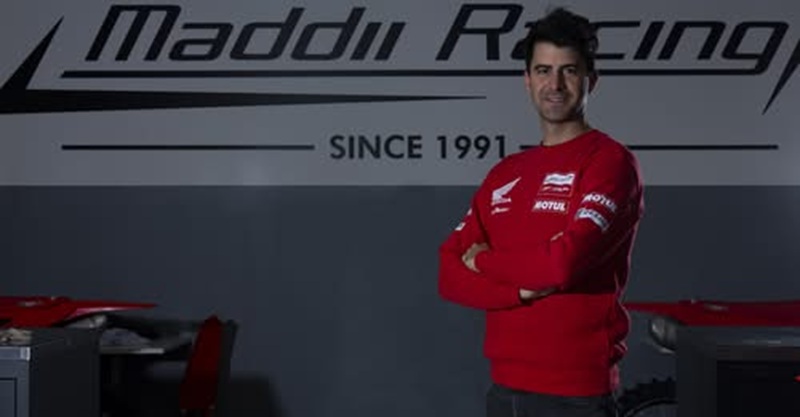
On the eve of the 2026 motocross season, Team Maddii Racing Honda Italia – ABF Italia lines up with a renewed structure and a new sporting project. Team Manager Marco Maddii looks ahead to the season, the team’s ambitions, and the challenges facing the sport.
Marco, we are at the start of the 2026 season and the team is entering with a new setup. How are you approaching this new adventure?
“Yes, it’s a new adventure and a new class. We are back working with young riders, we are highly motivated and we strongly believe in this project. We are in a good position, but this is obviously just the beginning of a new journey, so we need time to grow and continue developing.
At the moment, we are working intensively on the development of both the engines and the suspension. For this reason, we don’t expect to be right at the top in the first two races, but these events will be an important benchmark to understand more or less where we stand.
Winter training went well for everyone. We will line up with three riders, although Escandel will be absent as he is recovering from an injury. Expectations for the season are high with Rossi and Alvisi, but also with Escandel and Mannini. The potential is there, and our goal is to get the maximum out of these riders. If we succeed, we can certainly achieve important results.”
Team Maddii Racing has been a leading force in motocross for many years, in a way following in the family footsteps. What motivates you to always give your best and continue investing in this sport?
“Without a doubt, it’s the passion and the enjoyment I get from this job, something I’ve always had. I experienced it already as a child, when my father was personally very involved in the team. I love this sport because I’ve been part of it my entire life, and I also really enjoy the role I’ve had in recent years.
What drives me is the satisfaction this work gives me. I honestly can’t imagine doing anything else. That’s my motivation to keep improving and growing our organization, with the aim of making it a global benchmark in the future. The desire to grow is always there, there’s still a lot of work to do, and motivation is certainly not lacking.”
How do you prepare your riders for the first races of a season that promises to be demanding in every respect?
“The winter period is when you build the foundations. In Italy, the weather conditions are not always ideal, which can make working difficult. That’s why during winter we mainly focus on basic training, with long sessions emphasizing endurance.
So far, we haven’t worked much on pure speed, focusing instead on starts and overall conditioning. The goal was to ride on difficult tracks and in all conditions. We trained in mud, sand, and on heavily rutted circuits. We really experienced everything this winter, and it was a valuable experience for everyone.
Now that the races are approaching, we are obviously starting to work more on speed and focusing even more on starts. From a physical point of view, the riders have done an excellent job, with a lot of strength training in the gym. Endurance is mainly developed on the bike, while in the gym we work on strength, but also on agility, balance, and coordination. That forms the basis of our winter training.”
The motocross market remains stable and healthy. As one of the youngest team managers, what do you think can be done to attract more spectators to the track?
“I think one of the weak points of our sport is the infrastructure. The reception at many tracks is often not ideal, and that can discourage people. We really need to make progress in this area. The paddocks, sanitary facilities, general services, and catering are often below standard, and that’s an issue.
In addition, the quality of TV coverage is another key point. By investing more—while understanding that it is a budget-related matter—there is a lot that can be improved in terms of image quality and presentation. A lot is possible, but it is linked to the overall level of the sport. As long as it remains difficult to attract major sponsors, it will be hard for organizers to invest heavily in television production. It’s a vicious circle that needs to be broken. In my opinion, the first step is improving the facilities at the tracks.”